



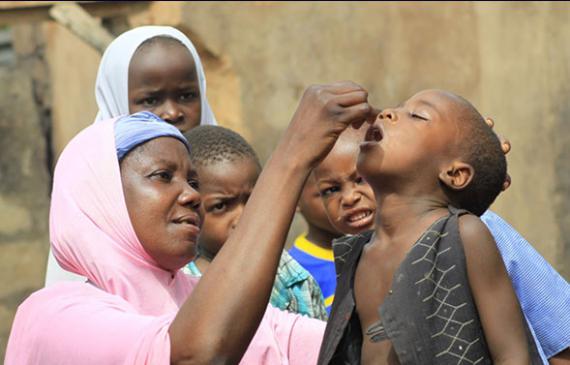
The Global Polio Eradication Initiative (GPEI) is a public–private partnership led by national governments and spearheaded by the World Health Organization (WHO), Rotary International, the United States Centers for Disease Control and Prevention and the United Nations Children’s Fund (UNICEF). Its goal is to eradicate polio worldwide. Today, Daily Development interviews Bruce Aylward, Assistant Director-General for Polio and Emergencies at the World Health Organization, who talks about GPEI past, present and future.
DD: Why is it so important to completely eradicate polio?
BA: Polio is a devastating, deadly, epidemic-prone disease that was paralysing over 350 000 children every single year when GPEI was launched.
Completing polio eradication will yield huge humanitarian and economic benefits. Today, more than 10 million people who would otherwise have been paralysed by polio can walk. Completing eradication will also result in huge financial savings, estimated to be at the very least US$ 50 billion for the world’s poorest countries alone over the coming 20 years.
Finally, completing eradication is a tremendous exercise in social justice and equity and will ensure that all children, everywhere, have access to the most basic of health services.
However, as long as polio exists it can and will resurge and endanger great numbers of people. The only way to completely eradicate any risk from the disease is to completely eradicate the virus itself.
DD: Why has a Public Health Emergency of International Concern been declared over polio?
BA: Globally, there are only three countries that have never stopped polio: Afghanistan, Nigeria and Pakistan. India—and the entire South-East Asia region—was certified polio-free in March, a feat which many thought could never be accomplished. Overall, since the launch of the eradication effort in 1988 the incidence of the disease worldwide has declined by 99%. However, this progress has continually been threatened by the reinfection of polio-free areas. Finally, in 2012, the international spread of the disease was virtually stopped due to a combination of new vaccines and new tactics.
After this incredible progress GPEI has made towards ending polio forever, the last thing we can afford is to have the virus again spread across borders. Unfortunately, this is precisely the scenario we have been faced with recently. Polio is a highly contagious disease, and in the last 12 months we saw new outbreaks in the Middle East, the Horn of Africa and central Africa. Since the beginning of this year alone the virus has already been carried to three new countries. This timing is especially worrying because January to April is the low season for the transmission of polio.
After carefully examining this situation, the WHO Director-General declared this problem a public health emergency of international concern, only the second such emergency in history. Most importantly, the three countries that are currently exporting the poliovirus—Cameroon, Pakistan and Syrian Arab Republic—have been asked to ensure that all travellers receive an additional dose of polio vaccine before leaving the country to ensure that the virus does not leave with them. It’s an extraordinary step in the global fight to eradicate polio.
DD: How does the polio vaccine play a role in polio eradication?
BA: The oral polio vaccine (OPV) is the foundation of the entire polio eradication effort. Without it there would be no means to interrupt human-to-human transmission of this virus in many parts of the world. There is also a second polio vaccine, the inactivated poliovirus vaccine (IPV).
With the launch of the Polio Eradication and Endgame Strategic Plan 2013–2018, we’ve now entered a new era in the eradication initiative during which both vaccines will have a critical role. OPV will remain the foundation for rapidly immunizing huge numbers of children in the remaining infected countries, but IPV is also now being introduced into all routine immunization programmes to boost the impact of OPV in the final stages of eradication and to provide long-term security against any future risk of polio reintroduction into a polio-free world.
DD: How are you planning to get rid of the remaining 1% of polio?
BA: Eliminating the last 1% of polio in the world requires knowing exactly where the virus is and ensuring the children in those areas, and surrounding areas, are highly vaccinated. Our job at WHO is to help countries do that.
Highly sensitive disease surveillance is absolutely essential for us to quickly detect the virus in humans (and, occasionally, in the environment), respond effectively to outbreaks and ensure the last reservoirs of the disease are mopped up.
Immunization is obviously key in the fight against polio. As the governments work to vaccinate their children, we work with them and with UNICEF and the GAVI Alliance to make sure that there is a sufficient supply of vaccines for those who need them. The heart and soul of the eradication effort, however, are the millions of parents, volunteers, communities and civil society organizations, especially Rotary International, that support them.
Contributor

Bruce Aylward is the Assistant Director-General for Polio and Emergencies, which brings together the World Health Organization’s (WHO) work in polio eradication and humanitarian response.
Since 1998, Dr Aylward has been responsible for the oversight and coordination of all polio eradication activities across WHO's regional offices and the Global Polio Eradication Initiative partnership. He oversaw and managed the scale-up of the Global Polio Eradication Initiative, which since 1997 has expanded to operate in every polio-affected country of the world and reduced the number of polio-endemic countries to three.
Post a comment