



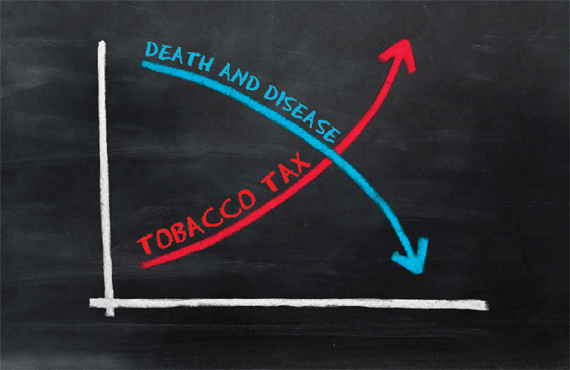
Raising tobacco taxes is the most cost-effective way to reduce tobacco use, especially among young people and the poor. A tax increase that increases tobacco prices by 10% decreases tobacco consumption by about 4% in high-income countries and by about 5% in low- and middle-income countries, says Ayda Yurekli, a World Health Organization economist in charge of the Raise Tobacco Tax, Lower Death and Disease campaign.
DD: Tobacco kills more people per year than AIDS-related illnesses, tuberculosis and malaria combined and is a major cause of the rapidly growing prevalence of noncommunicable diseases in the Global South, yet it is still not recognized as an explicit development problem. Why do you think this is the case?
AY: I believe that an increasing number of governments have been recognizing tobacco use and its consequences as a hurdle for their development progress. If the current conditions continue, by the end of the twenty-first century tobacco will be responsible for the deaths of 1 billion people, and 80% of this burden will be borne by developing countries. Luckily, 178 governments have made a commitment to control this human-made catastrophe by ratifying the World Health Organization Framework Convention on Tobacco Control (WHO FCTC).
DD: WHO calls for higher taxes, but don’t higher taxes promote illicit trade, thus undermining tobacco control policies and jeopardizing governments’ expected revenues?
AY: It is correct that illicit trade and production undermine tobacco control policies. However, the argument that higher tobacco taxes will increase illicit trade is perhaps the myth most perpetuated by tobacco manufacturers.
Although higher tax/price differences create financial incentives for tax avoidance and evasion, evidence shows that other enabling factors are of equal or greater importance. These include weak governance and the lack of high-level commitment, ineffective customs and excise administrations, corruption and the complicity of cigarette manufacturers and informal distribution channels.
Evidence shows that, regardless of the levels of illicit trade that countries face, significant increases in taxes on tobacco products have been demonstrated to be the most effective and cost-effective strategy for reducing tobacco use, particularly among young people and the poor. Furthermore, due to low price elasticity and the share of tax in retail prices, higher taxes generate significant revenues for governments. WHO has worked with 73 countries, and the countries that implemented higher taxes have generated higher revenues, despite the illicit trade risks.
DD: You mentioned that higher taxes are particularly effective on the poor, but don’t you think that higher taxes will unfairly burden them?
AY: In most countries, the poor tend to exhibit a higher prevalence of tobacco use than middle and high-income groups. They also have fewer savings or assets available to mobilize when they become sick from smoking-attributable diseases. Additionally, the provision of public health services in many low and middle-income countries is inadequate, meaning that the poor often have unmet needs with respect of their health care. Thus, as things stand, the poor suffer the greatest burden in relation to the negative health and economic impacts of smoking. The poor are also known to be more price-sensitive, due in part to their greater budget constraint. Thus, poor populations tend to reduce and quit smoking the most when tobacco prices increase due to taxation. On the other hand, higher-income people are less price-sensitive, meaning they respond less to higher tobacco prices. In this respect, raising tobacco taxes is a progressive or pro-poor tax policy because the poor benefit the most by quitting and avoiding death and disease from tobacco use. The money saved by those who quit or cut down can be put towards core household expenditures, such as food and heating. At the same time, following a tax increase, it is tobacco users from among the middle and high-income groups that tend to pay proportionately more tobacco taxes. The revenue from the tax increases can be put by the governments towards pro-poor social programmes, such as health and education.
Smoking also has an immediate negative impact on living standards by diverting scarce household resources. A survey in China from 2002 examined expenditures among 2400 households across south-west China. Cigarettes constituted 7.7% of family expenditures in poor/near-poor urban smoking households and 11.1% of family expenditures in poor/near-poor rural smoking households. Smoking households showed a clear reduction in spending on other household necessities, such as food, housing and education. Other studies have found that up to 17% of household income is spent on tobacco products. Cigarette expenditures can reduce the nutritional status of low-income households by displacing expenditures on food. A study in Bangladesh estimated that 10 million people currently malnourished could have an adequate diet if money spent on tobacco were spent on food instead.
Therefore, implementation of tobacco control policies, including raising tobacco taxes, will save lives, reduce smoking-related costs, increase economic productivities and improve standards of living.
DD: Are taxes the only effective measure to reduce the global tobacco epidemic?
AY: International efforts to advance tobacco control efforts took a major step forward on 21 May 2003 when the WHO FCTC was adopted by the World Health Assembly. The FCTC emphasizes the importance of reducing demand rather than restricting supply. In 2008, WHO released the MPOWER package of six tobacco control measures to assist countries implement the provisions of the FCTC: (1) monitor tobacco use and prevention policies; (2) protect people from tobacco smoke; (3) offer help to quit tobacco use; (4) warn about the dangers of tobacco use; (5) enforce bans on tobacco advertising, promotion and sponsorship; and (6) raise taxes on tobacco. Although tobacco taxes are the most cost-effective measure to control tobacco use, the effectiveness of higher taxes can be further enhanced when they are implemented as part of a comprehensive tobacco control strategy.
A recent study assessed the impact of MPOWER over the first three years of implementation. The authors restricted their analysis to countries that had fully implemented at least one MPOWER measure between 2007 and 2010, and found that these actions resulted in 14.8 million fewer smokers compared to the 2007 baseline and prevented 7.4 million smoking-attributable deaths. The authors concluded that tobacco control measures have enormous potential to reduce deaths and disease from smoking, but cautioned that the measures with the greatest impact—smoke-free air laws and taxation—remain alarmingly under-adopted in many countries.
DD: How high should the taxes be?
AY: This is a complex question that depends on the government’s commitment to prevent tobacco use and protect young people from becoming smokers. WHO suggests that the excise tax share in the retail price can be as high as 70%. There are a number of countries that have already met this threshold, including Brunei Darussalam, Cuba, Egypt and the United Kingdom of Great Britain and Northern Ireland.
Contributor

Ayda Yurekli is Coordinator, Tobacco Control Economics, for the World Health Organization Tobacco Free Initiative, part of the Noncommunicable Diseases and Mental Health cluster at WHO headquarters.
Post a comment