



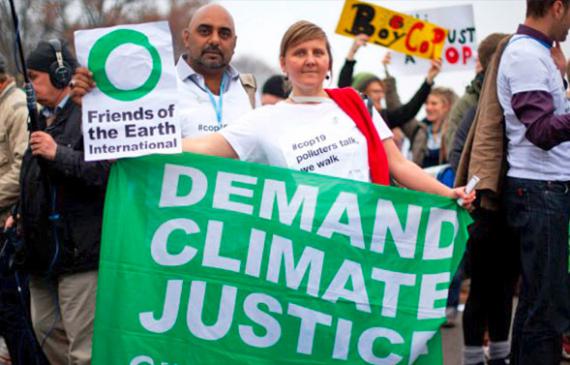
In the last of this week’s posts on the environment, Asad Rehman, Head of International Climate at Friends of the Earth, talks to Daily Development about climate change, his passion for social justice and how the two are interlinked—and how change is possible with people power.
DD: How does climate change contribute to the larger vision of development and equality?
AR: Climate change is not simply an environmental issue, it is the greatest issue affecting humanity because of the inequalities it delivers. It affects the most vulnerable sections of society and deepens the inequities within countries and the divide between the North and the South.
Whether it’s the threat of collapse in agriculture in the African continent, or in the bread basket of the Mekong delta, which affects the lives of millions of people, or pushing people already living precariously over the edge in terms into making everyday conditions even more difficult, climate change affects the poorest section of global humanity. It affects societies across the board. It is a cross-cutting issue: from solid fuels and energy, to carbon dioxide in the atmosphere and forests.
Over 1.2 billion people—20% of the world's population—are still without access to electricity, almost all of whom live in developing countries. This includes about 550 million in Africa, and over 400 million in India. Access to electricity must be environmentally and socially sustainable. About 2.8 billion people use solid fuels—wood, charcoal, coal and dung—for cooking and heating. Every year fumes and smoke from open cooking fires kill approximately 1.5 million people, mostly women and children, from emphysema and other respiratory diseases. Averse weather impacts, changes in weather systems, such as typhoons like the one that hit the Philippines recently, really hurt countries that don’t have the capital resources to respond to these disasters year after year. Even for wealthy countries like the United States of America, there is lasting impact. Today, there are still parts of New York that have not recovered from Hurricane Sandy; imagine the impact on countries like the Philippines.
DD: Tell us how you got involved in climate change and what motivates you to do the work you do.
AR: I feel passionately about social and economic justice, and I recognized that despite all the work we were doing in tackling social and economic inequalities and working with movements and communities, all that was at risk because of the climate crisis. Lack of willingness to tackle the type of change that is needed is what initially drew me. The climate crisis is akin to one of the biggest challenges humanity has faced. I see that it is similar to the anti-apartheid movement. We need to support the millions of small farmers. The climate crisis connects people in the North, with our production and consumption models, and helps us understand that we live on a planet with limits. At the moment, a small group of elite consume the majority of the resources. As more people buy into the idea of the western model, wanting to live the same lives as we live, we come to realize it is unsustainable. We recognize that the model of consumption we are living in has not brought happiness to the majority of the people; it’s very good for us as individuals and communities that we want to develop.
Some people who work on the climate change issue believe in it from an environmental impact perspective—it’s about icebergs melting, sea levels rising, polar bears potentially going extinct; and yes, we need to find a solution to this. However, my journey to this was via people: justice, both social and economic. I am not simply looking at the eco perspective. I am looking at solutions that can also build on equality and economic issues. The reality is that anybody who works on the climate issue without engaging and mobilizing powerful public voices won’t be able to make the changes that are needed. You can’t build that kind of support by talking about only saving the polar bears and temperature rises. It needs to involve a more holistic approach.
DD: What is a typical day for you?
AR: I lead the work on international climate change, and that means I focus on both international climate negotiations and the multilateral process. I do lobbying at the national, European Union and global level. I monitor the response of the United Kingdom and the European Union and need to make sure that they are doing their fair share, living up to their responsibilities of the conventions. I am also active in building and developing advocacy and global campaigns; working with allies and partners and other movements. Or I am often at the other side of the world organizing strategy meetings: how to connect people, networks and movements, how to reframe the climate change issue in a way that people can relate to.
I am fortunate that I work with people from all over the world, many at the front line working with the people most impacted by climate change. Working with those people is an honour and very inspirational. Many things that we take for granted, such as Internet access, and the everyday realities of being a campaigner or organizing in places where everything is that much more difficult, makes one realize how fortunate we are. They are also inspiring and fun, and in that sense it is very human—they bring the beauty of what people bring to the table; it’s not just a dry technical issue. There are many demands coming from communities themselves. I am very fortunate to work for an organization that very much believes in local to local and local to global.
I choose to do this, because it is the right thing, but also because I am very fortunate to be able to do this.
DD: If you had one message to share with this audience regarding climate change, what would it be?
AR: The biggest message is that change is possible. All change throughout history has been because of the actions of ordinary people coming together to transform the world that we live in. The climate change challenge will require people to come together again, because we have real power. Sometimes people forget that if we can use that power effectively, then politicians and business leaders will listen. It’s called people power.
Contributor
Asad Rehman leads the work on international climate issues at Friends of the Earth EWNI and is active in Friends of the Earth International, the world's largest grassroots environmental justice federation. He previously worked for Amnesty International and continues to be active with grassroots anti-racist and civil liberties organizations. His background is in social justice issues. He was a founder of the anti-war movement in the UK and active in the anti-globalization movement.
Post a comment