



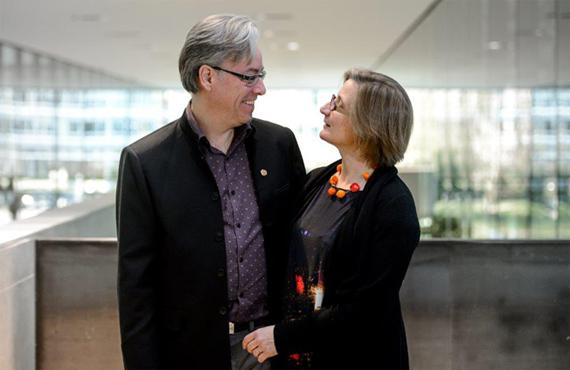
Kent Buse: We first met in Bangladesh.
Sarah Hawkes: My journey to that meeting started when I won a competition run by the newspaper The Observer, the UK’s Trade Union Congress and British Airways. My prize—a summer of travel to the industrial heartlands of central India, Hong Kong and southern China, all the while accompanied by Miss British Airways—afforded me the chance to witness first-hand labour conditions and see rural and urban poverty for the first time. It spurred me into action.
I ditched plans to study chemistry and French, and opted to pursue medicine as I thought it held the potential to do some good and to travel in its service. I soon found myself back in India, first cleaning hospitals in Orissa then working with Mother Theresa in Calcutta. I went to medical school and became involved in the world of AIDS activism in 1984. After five years at the Terrence Higgins Trust I landed my first research experience with people who inject drugs and sex workers in San Francisco. More travel, more research, more work with marginalized and vulnerable people, and more questions about the world, soon followed.
Kent: Our paths to Bangladesh differed markedly. I had started an undergraduate degree in engineering but found I had a greater appetite for engineering social justice. Four months living with a family in an Indonesian village which lacked not only running water and electricity but also any means of adding-value to the fruits of the labours in the paddy fields and jungles puzzled me—how is it some people work so hard for so little and what can be done to change it. It led me initially to the field of development studies and then to work on primary health care in Nigeria and micro-enterprise in Vietnam and later to UNICEF in the South Pacific. The question still gets me out of bed in the morning.
But in 1995 we were both in Dhaka, Bangladesh. By then Sarah was running a large study to determine if the latest magic bullet to treat Sexually Transmitted Infections—which had proven effective in east Africa—would work in low prevalence and culturally conservative Asian settings to control HIV.
I was looking at the impacts of interagency politics on health policy in the country—asking questions like: “Could a donor coordination mechanism—tame institutional rivalries and ensure that development aid was wisely spent?”
We met when I asked Sarah for help with using a fax machine. She would no doubt claim that my technological limitations continue to this day, but I like to think that it is simply a reflection of our different but complementary skill sets.
Sarah: From Bangladesh our journeys became entwined.
Kent: Wanderlust was among our shared afflictions.
Sarah: The following year we submitted our PhD theses on the same day—part romantic gesture but partly a reflection of our evolving academic partnership. Although researchers, we shared the Marxist position that the point was not simply to understand the world, but ultimately to change it. Our experience had taught us that understanding, let alone overcoming the wicked problems of development, required interdisciplinary collaborations. Perhaps more importantly we agreed that even if messy, frustrating and time-consuming, bridging the gaps between researchers, decision-makers, and also those living any given problem, was central to progress in development.
We embarked simultaneously on the process of starting a family as well as a partnership to leverage our understanding of politics to ensure better evidence-informed policy and practice in global health. Our work has taken us from Abbottabad to Zhejiang, and has encompassed issues as diverse as the rights of transgender sex workers in Pakistan to describing the political power at play in keeping risk factors for non-communicable diseases off the global health agenda.
Over the years we have worked together on a range of challenges from inside and outside academia—but always in partnership and always provoking each other to question assumptions and complacencies in the global health arena.
Our next contributor post will take us back to the partnership we established in Pakistan to get more evidence-informed HIV policy and services for vulnerable groups.
Contributor
Comments
James (not verified)
|Dec. 08, 2013 at 08:49 am
Flora (not verified)
|Jan. 27, 2014 at 06:01 am
Anna (not verified)
|Jan. 30, 2014 at 14:48 pm
Post a comment