



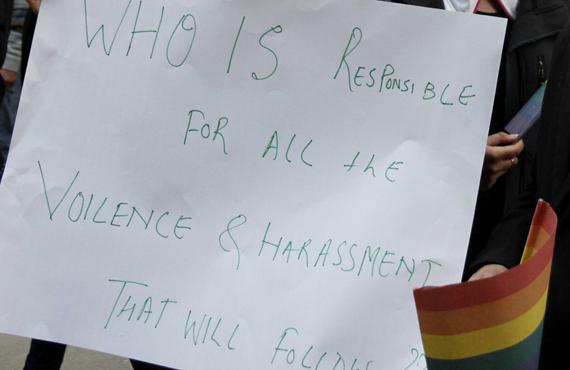
Twenty five years ago, for three years, Shreyesh* and I sat on the same wooden bench, as our Sociology Professor drummed it in our heads that man was a rational animal. We were friends. We skipped class, watched movies, ate in the same canteen and somehow got through college, together. A few years after graduation, I saw Shreyesh again at an AIDS training programme for peer educators. He kept ducking me, turning away. I thought I had recognized someone familiar, but could not place him immediately. At a session break, he managed to muster the courage to face me.
He told me he was gay. He was afraid I would not accept him and condemn him. Outside of his closed gay community, he had not told anyone, not even his mother, about his sexual orientation. His mother wanted him to marry a woman and give her grandchildren. It took him nearly 20 more years before he could hold his head high, and say to the world, “I am gay. I am a man”, without fear of prosecution and persecution. In 2009, the Delhi High Court restored his dignity.
Now, India’s Supreme Court has changed all of that. The rationality of man is out. Shreyesh is a criminal again in the eyes of the law, thanks to two judges, who deemed that Parliament, not the Supreme Court of India—the custodian of the rights of people of India—was competent to overturn an archaic imported law that was purged by the exporters themselves decades ago.
What were the Judges asked to ponder? They were simply asked to say “yes” to the following: “We declare that section 377 of the Indian Penal Code, insofar as it criminalizes consensual sexual acts of adults in private is violative of Articles 21, 14 and 15 of the constitution (of India)”. Notwithstanding what articles 21, 14, and 15 say, any person with common sense should be able to read the first part of the sentence and midway loudly exclaim ‘YES. YES. YES’. Instead, their Lordships meekly said no.
Article 14 enshrines equality before law and equal protection of laws; Article 15 prohibits discrimination on grounds of religion, race, caste and sex; Article 21 provides for protection of life and personal liberty. And article 32 gives us the right to go to the Supreme Court for the enforcement of these rights and enables the court to do so.
However, the judges felt it was up to the legislative branch – which for centuries has not taken up this issue since the law was first enacted in 1860 – to correct a wrong if it deemed appropriate, stating if they (legislators) have not thought it was wrong for all these years, it must be a right and just law. Oh…and on being told that the law had been expunged in the country of its origin, the judges have the gall to say, “We have grave doubts about the expediency of transplanting western experience in our country. Social conditions are different and so also the general intellectual level.” Really?
But you can’t have it both ways. One of the same Judges in a separate case took it upon himself (not trusting elected leaders) to dictate which official or elected leader in the country can have red flashing lights on their cars while they move about, in the name of preserving the dignity and equality of the people of India. Perhaps unsurprisingly, they reserved the colour red for themselves, assigning blue and yellow to life saving services such as ambulances, police and the fire-fighters. Is it any wonder that we are seeing RED?
I wish I could, in true Indian tradition of solving street disagreements and disputes, by saying Jaane do na, let it go please, and move on. But I cannot.
The judges have violated the basic human rights of people. By categorizing lesbians, gays and bisexuals or transgender people as “a miniscule fraction of the country’s population”, they have held them not equal or worthy of equal treatment before law. Stating that a mere 200 people were prosecuted in the last few years does not make the injustice go away. Is one wrong not enough? Does justice and rights have to be negotiated like buying Brinjals in the vegetable market by weight?
So what are the options?
One, the Supreme court redeems itself by suo moto taking cognizance of the massive public outcry and sets aside the two-judge judgement while upholding the historic judgement of the Delhi High Court which said, “the nature of the provision of Section 377 IPC and its purpose is to criminalise private conduct of consenting adults which causes no harm to anyone else. It has no other purpose than to criminalise conduct which fails to conform with the moral or religious view of a sections of society. The discrimination severely affects the rights and interests of homosexuals and impairs their dignity,” once and for all.
The alternative: the political party in power introduces an ordinance when parliament concludes next week scrapping the law and introduce a permanent bill when parliament reconvenes. Anything short would simply amount to empty promises and politicking.
A few weeks back, a friend and colleague told me that his 18-year-old daughter Shalini* had come out as a lesbian. My eyes welled up as he explained to me how father and daughter have conversations about love, heartbreak and growing up. I cannot see how this doting father will now suddenly see Shalini as a “criminal”. She will be his daughter, first and last. I do not see how Shreyesh will stop being a friend and become a criminal in my eyes. I also do not see how Shalini and Shreyesh and their loved ones will consider themselves or their private sexual behaviour as criminal acts.
Until our constitutional leaders with their flashing red lights act, let us find courage in the words of Nobel Laureate Rabindranath Tagore, “Where the mind is without fear and the head is held high; …where the mind is led forward by thee; into ever-widening thought and action; into that heaven of freedom, my father, let my country awake.”
*Names have been changed, so that I can harbour my friends and keep safe.
Contributor

A 20 year veteran of the AIDS response, Mahesh Mahalingam serves as the Director of the Office of the Deputy Executive Director, Programme at UNAIDS.
Comments
Ruben Mayorga (not verified)
|Dec. 19, 2013 at 13:48 pm
Post a comment