



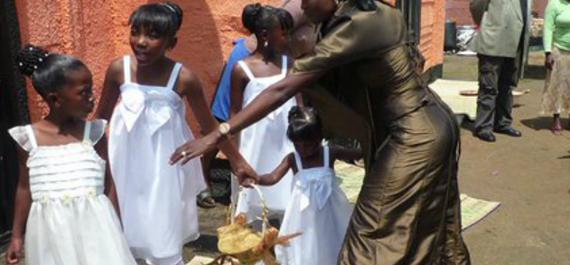
David Gere: As World AIDS Day approaches, I find myself thinking about the moment when I first tracked you down in London and asked you to come to Los Angeles to run an intensive workshop. My UCLA students and I were blown away by how you were able to present images of extremely ill people living with HIV in sub-Saharan Africa that didn’t make us feel pity. Instead, we could feel their inner strength, their love, their determination to live, their commitment to activism. And so I found you in London, rang you up, and told you how deeply affected I had been by your work.
Gideon Mendel: For me, the turning point was our first full-scale workshop in Mexico City, where we began the process of handing over the camera to HIV-positive people. With all the changes in the politics around the disease and the increasing availability of medication, I had begun to feel that I had nothing more to say as a photographer myself and was looking for a new way to take on my engagement with the issue.
David: That moment was extraordinary for me too, when we said, “Let the people living with HIV show us what they want to show us.” They took the reins. I especially recall how important it was to you and to Crispin Hughes, our fantastic photo educator, that there be a deep and thorough training period with the cameras.
Gideon: Yes, from the start, I have been fiercely advocating for the importance of all our final outputs being of the highest possible quality. While we do hugely value the process our participants go through, a strong final product makes for much more effective advocacy.
David: From your side, where did the idea of participatory photography come from?
Gideon: I was working in London with Crispin on a project across 13 London schools in deprived areas, engaging with pupils as the photographers. As we were planning our way forward with Mexico City, I had the idea of adapting some of the processes we had invented with London schoolchildren to working with HIV-positive adults.
David: From my side, I had been developing an umbrella project called MAKE ART/STOP AIDS, based on the idea that artists should be making work not to sell at auctions, to raise money for AIDS research, but rather to get right in there and fully participate in collective efforts to stop the epidemic. When the HIV-positive photographers in Mexico City took hold of their own cameras, I thought, “That's it. That's what MAKE ART/STOP AIDS is all about.” To me, their photographs are so much more intimate and expressive than any photography about AIDS that came before. Their images confront stigma and dissolve it.
Gideon: Twelve years ago I was very charged up with photography that supported the right of the poorest people in Africa to equal access to ARV medication. That was a truly important battle at the time. As that argument was won, and treatment became more widely available, it became clear that the next massive challenge both globally and in Africa is the fight against stigma. My sister, who is an HIV doctor in a Cape Town informal settlement, has very good access to medication but still has many patients dying because they test way too late—when they are severely ill. So the biggest killer is stigma.
David: In Mumbai, I found the impact of stigma to be more evident than in any other place we’ve worked. One of our participants, a young gay man, used the project as a way to be open about his status for the first time. A Christian pastor came out with HIV, and a Hindu swami, and a housewife. Powerful stuff. Gideon, now that the participants’ photographs are positioned at the heart of the project, what do you see as your role?
Gideon: As the participants become more self-reflective, I come to see my photographic and video work as essentially a tool to frame their remarkable images.
David: And is that sufficiently creative for you?
Gideon: Yes, it feels right.
David: What do you think makes our collaboration work?
Gideon: Together, you and I have developed a 'language,' and I have always appreciated the way that you have supported and enabled my crazy ideas.
David: [Laughing] Over time, I've learned to distinguish between your truly crazy and impossible ideas and the ones that are so good we just have to figure out how to make them happen. What do you foresee as the endpoint?
Gideon: It’s always difficult for me to let go of projects, but I think it is very important that we bring this one to a conclusion within the next year or so. It was never intended to go on forever. Do we make a coffee table book? Or exhibitions in major galleries? Or sets of posters to be distributed among organizations? So far we have had a high profile in the ‘AIDS world,’ at conferences, for example. My hope is that we can bring the images to a much wider and more mainstream public.
David: I myself would like the project to culminate in a kickass website, available to all, and a stunning exhibition, designed for museums and galleries but also, in a portable format, for intimate spaces such as schoolyards and community centres. Most of all, I want the photographers’ presence to be felt viscerally wherever we go, because in the end the project belongs to them.
Watch a short video piece by Gideon Mendel describing the development of his work on HIV/AIDS in Africa leading to the establishment of the global Through Positive Eyes project. http://vimeo.com/75972418
Contributor
RELATED
Post a comment