



It is a spectacular sunny day and I am leading a trip of five curious, inspired, fearless, grad students from New York University on a Rwanda field trip to research and provide recommendations to strengthen Foundation Rwanda's work and mission. We are meeting two of the Foundation Rwanda mothers Elianne and Agathe along with 10 other women in a district near the border of Congo that is barely reachable by car.
I watch the bobbing heads of three of the students in the back of a four-wheel drive as we spend nearly two hours navigating terrible dirt roads making our way to Elianne's village. I chose Elianne's house because I want the students to understand just how deep into the field Foundation Rwanda goes to support women and children who do not live near any aid organizations and who aren't even seeking aid due to the stigma of rape and HIV. I also want them to understand how rape as a weapon of war was used everywhere in this country.
The windows are rolled down, the views of the lush green of Rwanda's thousand hills are stunning and every now and then our car wraps around a turn, spitting and kicking red dust from the road, as the sun-kissed shimmering of Lake Kivu magically glistens like a painting in the distance.
Here in the heart of Rwanda, among the women we work with, it is about how to meet your most basic needs: food, health, shelter, water and education. All else simply falls away.
Twelve Foundation Rwanda mothers and children from this remote region are waiting when we arrive—along with many others from the village. Elianne's house is the only house big enough to convene the entire group. She remarried an older man with a good job in the local government and is doing "well" even though she still lives far below the poverty line. She pays her good fortune forward, taking in other children in need on holidays and providing meals when neighbours are hungry.
Together we bear witness not only to the depths of poverty and despair and to trauma from rape, but also to boundless joy and gratitude. We share photographs taken of some of the mothers when Foundation Rwanda first started five years ago. "I am no longer like that," says Annasarie, one of the women in the group. "I am doing better now."
And yet Annasarie lives on one meal a day, she is HIV-positive and does not have enough nutrition to take her ARV medication. She says that she feels sick most of the time. "Foundation Rwanda is the only place I get any financial support," she tells us.
I've been looking for Annasarie for two years. She moved houses and I could not locate her until now. I'm worried about her health, but her main concern at the moment is what to do about a small plot of land she has a down payment on to grow and sell cabbage. It is her only means of income. She is 90,000 RWF about US$ 143 short and the owner of the land has threatened to take it away from her.
Foundation Rwanda's mission is education and we already sponsor her son, so there is no further help we, as an organization, can offer her. At the end of the interview I explain that Foundation Rwanda can only sponsor education for her son but as her friend of five years I can’t bear to see her land and her opportunity taken away. I pledge to personally sponsor her $143 debt if she promises to use some of the money she earns from selling cabbage to take care of her health. She agrees and our eyes beam at each other.
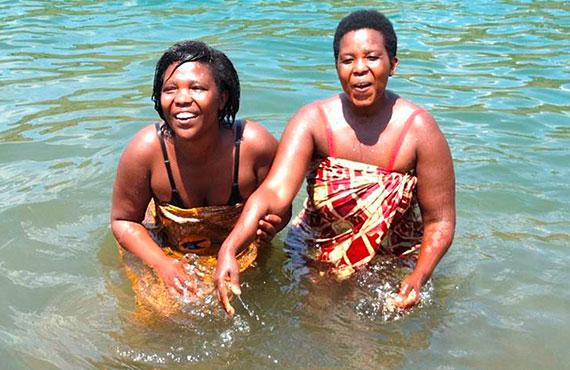
Later that afternoon, Elianne takes my hands and leads us down the path from her house to Lake Kivu. There is something to be said about friendships that transcend aid. When joy transcends pain. When we are bound together by the stunning beauty of the lake and the sun and the laughter inspired by a spontaneous swim with Elianne and some of the other women. Foundation Rwanda is our common tie but it is clear that we are bound by so much more—the very core of our own humanity. An audience gathers on the banks to watch, we are all laughing and splashing in the lake together under the Rwandan sky. It is magical.
On the last day, the team and I are crunching numbers—our goal is to make sure that each of the more than 700 students Foundation Rwanda sponsors will graduate from secondary school or vocational training with dignity. After careful consideration, we conclude that it will take at least US$ 1 million dollars to ensure that each child can attend secondary school and rise up from their fate. I don't know where the funding will come from but I know the families are counting on us. Today, at the lake, with these amazing women, it feels like anything is possible.
Contributor
Foundation Rwanda Started in 2008 in response to one mother’s wish that her child born of rape be able to attend school. Today Foundation Rwanda with local partners supports more than 735 students in school.
What keeps her hopeful? “Agathe. Her dream in life was to have her daughter born from rape attend school and to get her smile back. Agathe had her teeth knocked out by a militia man yielding a machete during the genocide. We worked with a very special NY dentist to craft her a new set of teeth. When Agathe got her smile back after 17 years, I asked, “What is the first thing you are going to do with your new teeth?” She replied, ‘Smile at the man who did this to me.’ ”
Links
Post a comment